


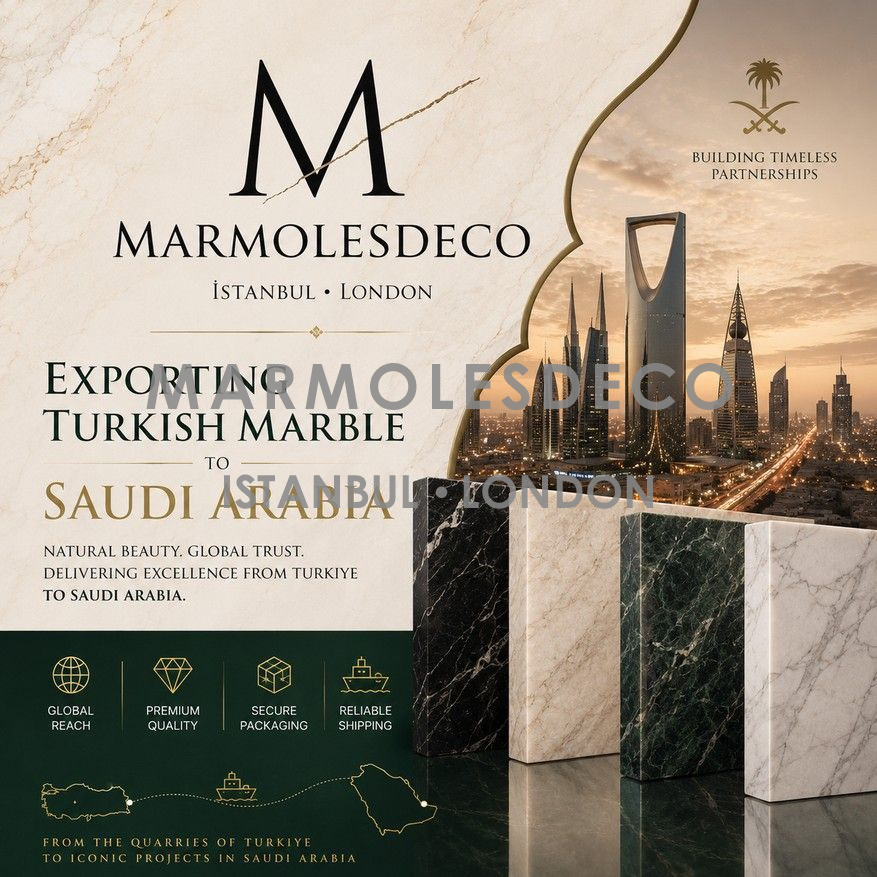
Exporting Turkish marble to Saudi Arabia is a strong opportunity for natural stone suppliers, contractors, importers and project developers working in one of the region’s most active construction markets. Saudi Arabia has a broad demand for marble in luxury residences, hotels, commercial buildings, offices, villas, restaurants, public interiors and large-scale development projects.
Turkish marble fits this demand well because it offers variety, production flexibility and strong architectural value. From warm beige marble for elegant floors to bright white stones for refined interiors, from modern grey marble to dramatic black and decorative varieties, Turkiye provides many natural stone options suitable for Saudi Arabia’s different project needs.
The real success of marble export is not only based on the beauty of the material. It depends on correct selection, accurate production, careful packaging, proper documentation and reliable shipment planning.
Why Saudi Arabia Imports Turkish Marble
Saudi Arabia’s construction and interior design market often looks for materials that feel premium, durable and visually refined. Marble has a natural advantage in this environment because it brings permanence, elegance and a sense of architectural value.
Turkish marble is attractive for Saudi buyers because it can support many design styles and project scales. A private villa may require soft beige floors. A hotel lobby may need large-format marble slabs. A commercial interior may prefer grey stone for a modern atmosphere. A luxury reception area may use black or decorative marble as a focal point.
White Turkish marble can be used in luxury bathrooms, hotel suites, villa interiors and wall panels where brightness, clarity and a clean surface language are important.
Beige Turkish marble is one of the strongest choices for Saudi projects because it creates warmth, comfort and timeless elegance across large floors, staircases, corridors and hospitality interiors.
Grey Turkish marble works well in modern offices, apartments, restaurants and commercial spaces where the design needs a calm, contemporary and balanced natural stone surface.
Black Turkish marble can create strong contrast in reception desks, fireplace walls, bar counters, private offices and selected feature panels where the project needs more depth and visual strength.
Decorative Turkish marble can be used in luxury villas, hotel entrances, restaurants and custom interior details where the marble should become a memorable design element rather than a quiet background.
This range gives Saudi importers and designers the ability to select materials according to both function and atmosphere.
Best Uses of Turkish Marble in Saudi Projects
Turkish marble can be used in many types of Saudi Arabia-based projects. Each area needs a different level of visual control, durability and production detail.
Private villas can use Turkish marble in entrance halls, living rooms, bathrooms, staircases and wall cladding areas where natural stone creates a bright, elegant and long-lasting interior identity.
Hotel lobbies can benefit from beige, white or decorative Turkish marble because guest-facing spaces need a material that creates a strong first impression while keeping the atmosphere refined and welcoming.
Luxury bathrooms can use white, beige or grey Turkish marble to create clean, spa-like surfaces that feel premium without becoming too visually heavy for daily use.
Commercial interiors can use Turkish marble on reception desks, corridor walls, office floors and selected counters where the surface must support a professional and high-quality brand image.
Restaurants and cafes can use marble for tabletops, bar counters, wall panels and decorative surfaces where natural stone improves the customer experience and adds visual richness.
Public and corporate interiors can benefit from calmer marble selections, especially beige and grey stones, because these colors create a polished environment without distracting from the function of the space.
Staircases and architectural details can be produced from cut-to-size marble pieces where accurate measurements, edge processing and tone consistency are essential for a clean final result.
For Saudi Arabia, marble selection should often balance luxury with scale. Large projects need stones that look elegant across wide surfaces, while special design zones can use more expressive materials.
Color Strategy for Saudi Arabia
Saudi interiors often use warm, refined and spacious design concepts. This makes beige and white Turkish marble especially suitable. However, modern projects increasingly use grey, black and decorative stones for stronger contrast and contemporary identity.
Beige marble is highly suitable for floors, corridors, staircases and villa interiors because it creates warmth and continuity across large areas.
White marble can be used in bathrooms, wall panels, hotel suites and luxury residential interiors where brightness and freshness are desired.
Grey marble gives a more modern and architectural tone, making it useful for offices, commercial spaces, restaurants and contemporary homes.
Black marble should usually be used as an accent material in feature walls, counters, fireplaces or reception desks because it brings contrast and visual weight.
Decorative marble can create signature surfaces in private villas, hospitality interiors and selected commercial zones where the project needs a unique identity.
A smart approach is to use calmer stones for large surfaces and stronger stones for focal points. This keeps the project elegant without making the interior feel crowded.
For buyers reviewing Turkish stones for Saudi projects, the Turkish marble products category can help compare different marble colors, patterns and project-ready natural stone options.
Product Formats for Saudi Marble Imports
A professional export order should define product format clearly. Saudi projects may need slabs, tiles, cut-to-size pieces, bookmatched panels or custom stone elements.
Marble slabs are ideal for wall panels, vanity tops, kitchen islands, reception desks, fireplace surrounds and custom furniture pieces where the natural movement of the stone should be visible in larger surfaces.
Marble tiles are widely used for floors, bathrooms, corridors, hotel areas and commercial interiors where consistent sizing, tone grouping and practical installation are important for a clean result.
Cut-to-size pieces are essential for stairs, risers, thresholds, skirting, window sills, wall cladding panels and architectural details produced according to exact project measurements.
Bookmatched panels can be used in luxury villas, hotel lobbies and feature walls where the marble needs to create a more decorative and carefully planned visual effect.
Custom marble elements such as tabletops, counters and decorative panels can support boutique projects where standard sizes are not enough for the design concept.
Saudi projects often include large areas and detailed architectural elements. This makes production planning, labeling and measurement accuracy especially important.
Surface Finish Selection
Surface finish affects both appearance and use. The correct finish should be selected according to where the marble will be installed.
A polished finish creates a glossy and reflective surface. It is often preferred for hotel interiors, villa walls, reception desks, vanity tops and decorative applications where brightness and luxury are important.
A honed finish gives a softer and matte appearance. It can be suitable for modern interiors, selected floors, bathrooms and spaces where the design should feel calmer and less reflective.
A brushed finish adds texture and can be used in special design concepts where the surface should feel more natural and tactile.
A leather finish may be preferred for counters, furniture pieces and decorative applications where both touch and visual depth matter.
The finish should not be chosen only by appearance. A polished wall may look excellent, but a floor with heavy use may require more careful finish planning. Good marble work is not about maximum shine; it is about correct suitability.
Quality Control Before Export
Before exporting Turkish marble to Saudi Arabia, quality control should be handled with care. Natural stone variation is normal, but it should be managed before shipment.
Important quality checks include:
Tone consistency should be reviewed before packing because large floors, hotel interiors and villa projects need marble pieces that feel visually connected rather than randomly mixed.
Surface finish quality should be checked with clear photos or videos because uneven polishing, weak honing or visible scratches can reduce the premium appearance expected in Saudi projects.
Thickness and size accuracy should be confirmed carefully because installers depend on correct dimensions for floors, stairs, wall panels, thresholds and custom stone pieces.
Vein movement should be reviewed for visible slabs because reception walls, bathroom panels, counters and feature surfaces look more refined when the natural pattern is planned before cutting.
Cracks, chips and edge defects should be inspected before shipment because replacements after delivery can delay installation and create additional project costs.
Labeling should be organized before loading because large projects often include many crates, areas and installation phases that must be easy to identify on site.
Quality control is the point where future problems are either prevented or quietly packed into the container. A careful inspection is always cheaper than a delayed project.
Packaging and Shipment to Saudi Arabia
Packaging is critical in marble export. Even when the destination is regionally accessible, marble still passes through loading, transportation, port handling, unloading and site movement.
Slabs should be packed in strong wooden bundles. Tiles and cut-to-size pieces should be placed in secure crates with separators, foam protection, plastic covering and clear labels. For project-based orders, crate labels should match areas, drawings or installation sequences whenever possible.
Good packaging protects the material and makes site handling easier. It also reduces confusion during unloading. A large project should not lose time because the crates are unclear or poorly organized.
Shipping terms should be confirmed clearly before the order. EXW, FOB, CFR and CIF each create different responsibilities and cost structures. Buyers should understand what is included in the offer and what remains under their responsibility.
Documentation and Export Process
Exporting Turkish marble to Saudi Arabia requires accurate documentation. Commercial invoice, packing list, product descriptions, quantities, weights, origin information and shipping documents should be prepared correctly.
Clear documents support customs clearance, warehouse handling and project delivery. Product names, crate numbers, measurements and quantities should match across all paperwork. For large orders, organized documentation can save serious time during receiving and distribution.
A professional exporter should manage these details carefully and keep the buyer informed before shipment.
Choosing the Right Turkish Marble Export Partner
A reliable export partner should understand both Turkish marble production and Saudi project expectations. The supplier should provide updated material photos, slab videos, finish confirmation, production updates, inspection images, packaging photos and loading details.
Good communication is essential because many Saudi projects work with strict schedules. Contractors, designers and developers need accurate information to coordinate installation teams and site planning.
A dependable exporter should not only promise quality. The exporter should prove it through selection control, production discipline, packaging standards and organized export communication.
Turkish Marble for Saudi Arabia’s Growing Project Market
Exporting Turkish marble to Saudi Arabia offers strong potential because the market values refined materials, large-scale project supply and long-term architectural quality. Turkish marble can support villas, hotels, commercial buildings, restaurants, bathrooms, floors, wall panels, staircases and custom design details.
The best results come from choosing the right stone for the right area, confirming the finish, checking production quality, preparing strong packaging and managing documentation carefully.
Turkish marble already carries natural beauty and material variety. The export process must protect that value until the stone reaches the project site. For Saudi buyers looking for elegance, flexibility and dependable natural stone supply, Turkish marble remains a strong and practical choice.
 Online Catalog